Saltwater in the Strings: How Canvey Island's Forgotten Landscape Forged the Rawest Guitar Sound in British Rock
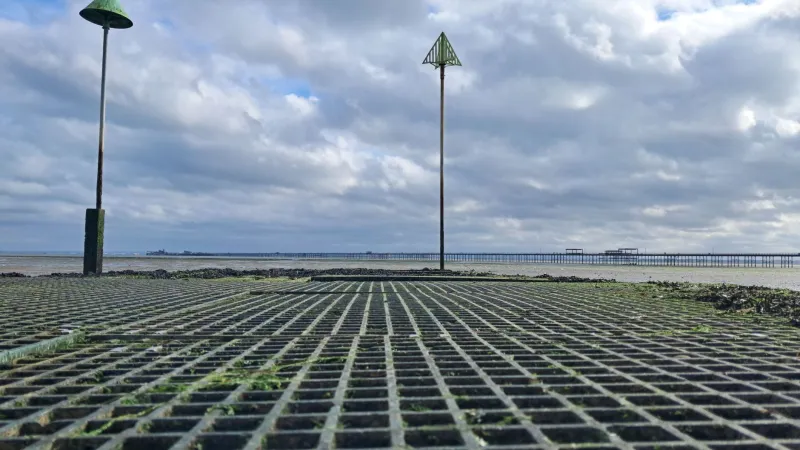
There's a particular quality to the light on Canvey Island. It sits low over the Thames Estuary, diffused by industrial haze and saltwater mist, flattening everything underneath it. The landscape doesn't offer much in the way of romance — refineries squat on the horizon, seabirds circle above mudflats, and the whole place carries the quiet weight of somewhere that history largely passed by. And yet, out of this unpromising corner of Essex, came one of the most viscerally alive guitar sounds Britain has ever produced.
Wilko Johnson didn't just happen to come from Canvey Island. Canvey Island is in Wilko Johnson — pressed into every choppy downstroke, every bug-eyed stare across a packed venue, every raw and relentless riff that made Dr. Feelgood feel like a force of nature rather than a band.
To understand the guitar, you have to understand the place.
An Island Apart
Canvey sits just off the Essex coast, connected to the mainland by a couple of bridges, ringed by a sea wall that was hastily reinforced after the catastrophic floods of 1953 killed dozens of residents and devastated the community. That disaster cast a long shadow. The island spent the following decades rebuilding — practically, emotionally, and in terms of its sense of identity. It was working-class to its bones, populated by people who'd come down from London's East End in search of cheap land and a bit of breathing room, and who found instead a windswept, semi-industrial outpost that demanded resilience just to live there.
This wasn't the kind of place that produced polished musicians. It produced people who played hard because that was the only way that felt honest.
"There was no pretension on Canvey," one long-term resident and local historian has noted. "You couldn't afford it, literally or figuratively. If you were going to do something, you did it straight, you did it loud, and you didn't dress it up."
That ethos — unvarnished, direct, slightly confrontational — is essentially a description of Wilko Johnson's entire musical philosophy.
The Sound of Somewhere Specific
British rock in the early 1970s was, broadly speaking, heading in one of two directions. Either it was floating off into progressive abstraction — concept albums, mellotrons, twenty-minute suites — or it was getting slicker, more polished, more American. Both tendencies were, in their own ways, a flight from the immediate and the local.
What Wilko Johnson did was the opposite. He rooted himself in the specific — in the choppy, two-guitar-less attack of rhythm-and-blues, in the snarling immediacy of American blues filtered through an Essex working-class sensibility, in a sound that felt like it came from somewhere, not from a studio calculation or a market research exercise.
The Canvey connection matters here more than it might seem. Islands, even small ones attached to the mainland by bridges, develop their own internal logic. They're self-referential in a way that larger places aren't. Canvey's musicians played to Canvey audiences before they played to anyone else, and those audiences didn't want sophistication. They wanted energy. They wanted music that felt like it understood their lives.
Wilko gave them that, and then he gave it to the rest of Britain, and it hit like a freight train precisely because it hadn't been softened for anyone.
Oil, Mud, and the Aesthetics of Grit
The physical landscape of Canvey Island in the late 1960s and early 1970s was genuinely peculiar. The Coryton oil refinery dominated the eastern end of the island. The Thames Estuary mud stretched out at low tide in vast, grey-brown expanses. The sea wall, that constant reminder of vulnerability, ringed the whole thing like a civic scar.
Musicians who grew up there absorbed this landscape whether they intended to or not. There's a reason the Dr. Feelgood aesthetic — all sharp suits and nervous energy, music stripped to its functional essentials — felt so different from the bucolic English rock of the era. There were no rolling hills in Wilko's frame of reference, no pastoral idyll to romanticise. There was the estuary, the refinery, the pub, the stage.
Local musicians who came up alongside Wilko in that period have spoken about the way the island's geography created a kind of cultural insularity that, paradoxically, became a source of strength. "We weren't looking over our shoulders at what London was doing," one contemporary recalled. "We were too far away, in our heads as much as anything else. So we just did what felt right."
What felt right, it turned out, was an attack on the guitar that owed more to the choppy urgency of the estuary than to anything on the radio.
Why It Couldn't Have Come From Anywhere Else
It's tempting to think of musical styles as portable — that the Canvey Sound could have emerged from any number of post-industrial working-class British communities. There's some truth to that. The broader conditions that produced Wilko Johnson's guitar playing — economic hardship, cultural isolation, a rejection of metropolitan sophistication — existed in plenty of places.
But the specific combination was unique. The East End diaspora community that had resettled on Canvey brought with it a particular attitude: entrepreneurial, resilient, suspicious of pretension, fiercely loyal to its own. The island's physical isolation reinforced that insularity. And the proximity to London — close enough to eventually reach, far enough to feel genuinely separate — gave the musicians who emerged from there a chip on their shoulder that translated directly into ferocity on stage.
Wilko Johnson has spoken in interviews about feeling like an outsider, about Canvey existing in a kind of liminal space between London and the English countryside, belonging fully to neither. That liminality — that being-between — is audible in the music. It's not quite blues, not quite punk, not quite R&B. It's something that grew in a gap, and gaps, as any guitarist will tell you, are where the most interesting things happen.
The Legacy of a Specific Place
Canvey Island today is different, obviously. The refineries are gone or diminished. The island has been absorbed more fully into the commuter belt. The specific post-flood, post-austerity working-class culture that shaped Wilko Johnson's formative years has shifted, as all cultures do.
But the music remains, and it remains specific. You can hear Canvey in it — the flatness, the refusal to ornament, the sense that every note has to earn its place because nothing comes easy on an island that the Thames once tried to swallow.
That's the thing about place and music, when the connection is genuine rather than manufactured. It doesn't wash out. Decades on, in venues up and down the country, when someone puts on 'She Does It Right' or 'Back in the Night' and that choppy, relentless guitar comes in, you're not just hearing a musician. You're hearing saltwater and mud and the grey Essex light and the stubborn refusal of a community to be anywhere other than exactly where it is.
Canvey Island made Wilko Johnson. And Wilko Johnson made sure Canvey Island would never be forgotten.