Back to the Island: Walking the Ground That Made Wilko Johnson
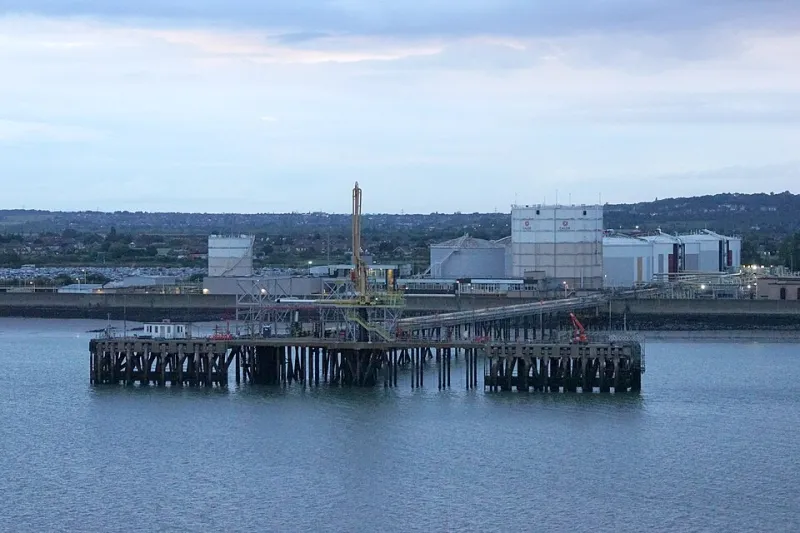
Photo: Mike Pennington , CC BY-SA 2.0, via Wikimedia Commons
The road onto Canvey Island crosses a low bridge over a narrow stretch of water and deposits you, without ceremony, into a place that doesn't quite feel like anywhere else. It's flat in the way that only the Thames Estuary can be flat — an uncompromising horizontality that makes the sky feel enormous and slightly threatening, even on a clear day.
You can see why it got under Wilko Johnson's skin.
I've come here on a grey Tuesday in late autumn, the kind of day when the oil refinery chimneys at the island's eastern end are wreathed in low cloud and the seafront promenade is largely empty. I want to understand what this place was, what it's become, and whether the geography that shaped one of Britain's most singular guitarists still has anything left to say.
What It Was
In the early 1970s, when Wilko was forging what would become the Dr. Feelgood sound, Canvey Island was a working-class outpost with a complicated identity. It had the feel of a seaside resort that had never quite made it — chalet parks, amusement arcades, the lingering optimism of postwar leisure culture slowly going to seed.
But it also had the refineries, the tankers on the Thames, the chemical plants visible from the shoreline. There was industry here, and with industry came a particular kind of community: tight-knit, unglamorous, not easily impressed. The kind of place that produces musicians who have something to prove and no patience for pretension.
"It was rough, and proud of being rough," says Terry Oakes, 71, who grew up two streets from Wilko and still lives on the island. "People didn't go in for airs and graces. You were who you were. I think that's what you hear in the music — that directness."
The Venues That Were
The pub circuit that launched Dr. Feelgood is largely gone now. The Canvey Island venues where they cut their teeth — the kind of sticky-floored, low-ceilinged rooms where you could feel the bass in your sternum — have mostly been converted, closed, or demolished entirely.
The Goldmine, once one of the island's most beloved music venues and a touchstone for the pub rock scene, is long gone in its original form. Where young men once packed in to watch Wilko stalk the stage with that wild-eyed intensity, there is now something more prosaic.
"That whole circuit just evaporated," says Donna Marsh, who runs a community arts project on the island and has spent years documenting its musical history. "It wasn't just Canvey — it was everywhere. The pub rock scene depended on a kind of economics that doesn't exist anymore. Cheap beer, cheap rent, bands playing for the door money. None of that adds up now."
Mars points out, with some wryness, that this makes Wilko's legacy both celebrated and slightly inaccessible on the island itself. "There's real pride in him here. But the infrastructure that created him? That's gone."
What's Changed
Modern Canvey Island is in many ways a more comfortable place than the one Wilko grew up in. The 1953 flood — a catastrophe that killed dozens on the island and left a collective scar on the community's memory — is now distant history, though the sea defences built in its aftermath are an ever-present reminder. Housing has expanded. The population is older and more settled.
The industrial character persists, but differently. The refineries are still there, still visible, still giving the eastern skyline its particular science-fiction quality. But they employ fewer people than they once did, and those they do employ are less likely to be local.
The sense of a community forged by shared labour — the thing that gave pub rock its social context — has softened at the edges.
"It's not the same kind of working class," says Oakes, choosing his words carefully. "It's not worse, necessarily. Just different. People don't all work at the same place, don't all drink at the same pub. There's less of that... collective thing."
The Ones Still Playing
But music hasn't left Canvey Island. It's just quieter, more scattered, operating in smaller spaces and with less infrastructure behind it.
I meet Jake Ferris, 24, in a rehearsal space above a storage unit on a light industrial estate near the waterfront. He plays guitar in a three-piece that describes itself, with some self-awareness, as "post-punk adjacent." He grew up on Canvey, knows Wilko's story, and has complicated feelings about the legacy.
"Everyone here knows who he is, obviously," Ferris says. "But I think for my generation, he's almost become... a heritage thing? Like something the older lot talk about. You have to make a bit of an effort to actually hear him properly."
Ferris did make that effort, and he's glad. "When I actually sat down and listened — really listened — I got it. The way he plays guitar is so physical, so direct. There's no distance between what he's feeling and what comes out. That's what I want to do. Whether I manage it is another question."
His bandmate, bassist Priya Shan, 23, who moved to the island a couple of years ago, offers a slightly different perspective. "I didn't grow up with him as a local hero. I came to him as just a musician. And honestly? He's brilliant. The geography stuff is interesting, but the music stands up completely on its own."
Can You Still Hear It?
Walking back along the seafront as the light fails, I try to answer my own question. The sky over the estuary is doing something spectacular — bruised purples and industrial oranges, the kind of sunset that feels almost theatrical against the flat landscape.
The grit is still here. The sense of a place that exists slightly outside the mainstream, that has its own rhythms and its own pride, that doesn't particularly care whether you approve of it — that hasn't gone anywhere.
Whether that translates into music the way it once did is harder to say. The conditions that produced Dr. Feelgood were specific: a particular moment, a particular community, a particular economic reality. You can't replicate those conditions.
But you can still feel the estuary wind. You can still see the refineries. And somewhere on a light industrial estate, a twenty-four-year-old is playing guitar with the directness of someone who has something to prove.
Maybe that's enough.