What Jazz Found in the Gaps: The Unlikely Reach of Wilko Johnson's Restrained Guitar Philosophy
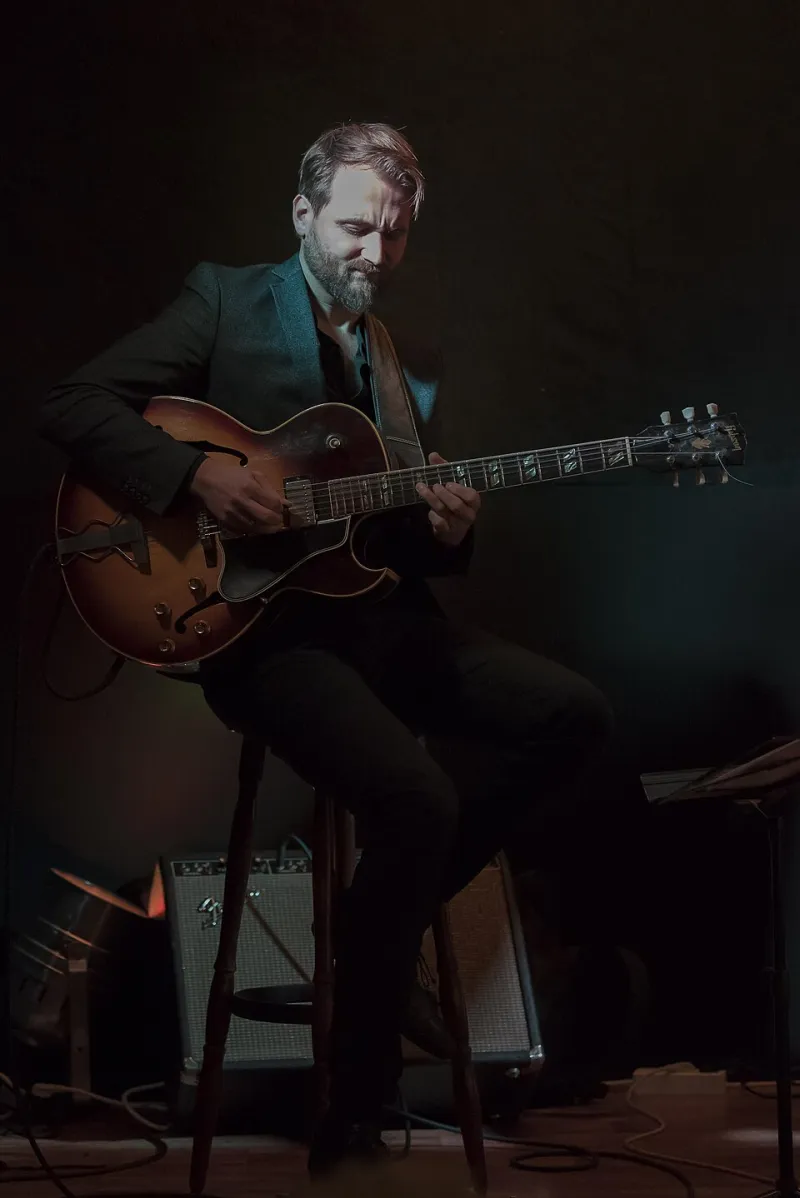
Photo: Stefan Barsch, CC BY-SA 4.0, via Wikimedia Commons
There's a moment in almost every Wilko Johnson performance where the guitar stops. Not because something went wrong. Not because he's catching his breath. It stops because Wilko wanted it to stop. That silence — deliberate, loaded, almost confrontational — is arguably the most radical thing he ever did.
In a world of guitar heroes who measured greatness in notes-per-second, Wilko went the other way. And it turns out that decision, made on the stages of Canvey Island and the pubs of Southend in the early 1970s, planted a seed that's still germinating in the most unexpected places.
The Philosophy Nobody Wrote Down
Wilko never published a manifesto. He didn't give masterclasses or write a book on compositional theory. What he did was play — and in playing, he demonstrated something that music schools struggle to teach: that what you don't play shapes the listener's experience just as powerfully as what you do.
His approach on tracks like She Does It Right and Back in the Night is almost architectural. Riffs are placed with the precision of load-bearing walls. There's no decoration, no noodling, no showing off. The groove lives in the tension between the notes, in the anticipation he creates and then — sometimes — refuses to resolve.
For rock audiences, this read as aggression. For musicians in other traditions, it read as something else entirely.
Jazz Ears Pricking Up
Ask a jazz musician about Wilko Johnson and you might expect a blank look. But dig a little deeper and you find genuine admiration, particularly among players who came up in the post-punk era and absorbed Dr. Feelgood alongside Coltrane and Miles Davis.
Manchester-based jazz guitarist and composer Asha Kinnear — whose quartet has released three critically praised albums on the independent circuit — describes Wilko as "the most honest teacher I never had."
"I came to him late, probably mid-twenties," she says. "I was deep into jazz, obsessed with chord substitutions and harmonic complexity. Then someone played me Stupidity live and I just sat there thinking — why is this so effective? He's playing nothing. And yet it's everything."
Kinnear says the revelation shifted her compositional approach. "I started asking myself, before every phrase I wrote: does this note earn its place? If I can't justify it, it goes. That's Wilko's lesson, even if he'd probably laugh at the idea of a jazz musician citing him."
She's not alone. Across the UK's independent jazz scene — from the venues of Bristol's Stokes Croft to the basement clubs of Leeds — a loosely connected cohort of musicians in their thirties and forties point to Wilko's economy as a touchstone. Not as an influence in the obvious, stylistic sense. More as a permission slip.
Electronic Music and the Art of the Held Note
The influence doesn't stop at jazz. Over in Bristol, electronic producer and sound designer Dom Ferreira has built a career on textured, minimal compositions that sit somewhere between ambient and post-club. His 2022 EP Estuary Static was described by one reviewer as "industrial poetry."
Ferreira grew up in Tilbury, close enough to the Thames Estuary to feel the cultural proximity to Canvey Island even if he didn't fully clock it at the time. He discovered Wilko through his dad's record collection, aged about fourteen.
"What struck me wasn't the guitar, specifically," he admits. "It was the structure of the songs. The way tension was managed. He'd build something and then just... not release it in the way you expected. That withholding — it's a production technique as much as a performance one."
Ferreira says he consciously applied that logic to his electronic work. "In synthesis, you're always tempted to fill the frequency spectrum. Every layer feels like it's adding something. But Wilko taught me — or at least, his music did — that negative space is where the listener's imagination lives. You give them a gap and they fill it themselves. That's powerful."
Restraint as Radical Act
There's something almost countercultural about what Wilko's philosophy represents, especially when viewed through the lens of contemporary music. We live in an era of maximalism — streaming algorithms that reward density, producers who layer until the mix is gasping for air, guitarists who equate speed with skill.
Against that backdrop, Wilko's approach looks less like simplicity and more like a deliberate refusal. A political stance, almost.
Kinnear puts it bluntly: "In jazz, there's always pressure to demonstrate how much you know. Audiences expect complexity. Critics expect complexity. Wilko is a reminder that confidence is knowing when to play two notes instead of twenty. That takes more nerve than a blazing solo."
Ferreira agrees, from his very different vantage point. "Minimalism in electronic music is fashionable right now, but it can become its own kind of showing off — look how stripped back I am, how clever. Wilko's restraint wasn't aesthetic posturing. It was functional. It served the song. That's the difference."
The Ripple Keeps Moving
What's remarkable about Wilko Johnson's influence on these musicians is how indirect it is. Nobody's writing twelve-bar blues in a jazz fusion context and calling it Wilko-inspired. Nobody's sampling Roxette in a Bristol club night.
The influence is philosophical. It's a way of thinking about music — about what notes are for, about the relationship between sound and silence, about the courage required to hold back when every instinct tells you to push forward.
For a man who played with the physical intensity of someone possessed, Wilko Johnson's quietest legacy might be teaching a generation of musicians in completely different genres how to breathe.
Not bad for a bloke from Canvey Island who just wanted to play the blues.