Before Punk Broke: How Wilko Johnson Handed British Rock a New Rulebook
There's a moment in the mid-1970s that British music history tends to skip over. Everyone knows what came before it — the bloated prog epics, the twelve-bar blues marathons, the rock gods with their endless solos and their velvet capes. And everyone knows what came after — the Year Zero fury of punk, the angular cool of post-punk, the restless invention of new wave. But tucked in between those two worlds, barely acknowledged in most official accounts, was a bloke from Canvey Island playing a battered Telecaster like his life depended on it.
Wilko Johnson didn't just anticipate the revolution. In many ways, he started it.
The Sound That Shouldn't Have Worked
Let's be clear about what made Wilko so strange in the context of early 1970s British rock. Here was a guitarist who refused to solo. Who played rhythm and lead simultaneously, using his right hand like a machine gun and his left like a vice. Who kept everything lean, tight, and almost brutally simple. At a time when the dominant guitar culture worshipped at the altar of lengthy improvisation — your Claptons, your Pages, your Becks — Wilko was doing something that looked almost perverse.
He was playing less.
Not because he couldn't play more. Anyone who's watched the man stalk a stage, eyes wide, coat flapping, knows there's something almost supernatural going on. But Wilko had arrived at a philosophy that the wider rock world wouldn't catch up with for years: that tension, rhythm, and economy were more powerful than showing off. Every note had a job to do. If it wasn't working, it was out.
The result was a guitar sound that hit like a punch rather than a wave. Short, choppy chords fired in rapid succession, a bass-heavy rumble underneath courtesy of John B. Sparks, and Lee Brilleaux's voice cutting through it all like a blunt instrument. Dr. Feelgood, at their peak, sounded like nothing else on the British circuit — and that was entirely down to the framework Wilko had built.
The Ripple Effect
Punk arrived in 1976 with a great deal of noise about how it had invented itself from scratch. That was always a bit of a myth, and most of the people involved knew it. Joe Strummer, before The Clash, had been playing in a pub rock outfit called the 101ers. He'd seen Dr. Feelgood live and reportedly came away shaken by the experience — suddenly aware that his own band felt slow and self-indulgent by comparison.
Strummer wasn't alone. The Feelgood's 1976 live album Stupidity went to number one in the UK charts without a single to support it, which tells you everything about how hungry British audiences were for something that felt real. The album crackled with the kind of energy that the punk bands would soon claim as their own — but it was already there, already happening, in Canvey Island of all places.
Look at the early Clash recordings and you can hear Wilko's fingerprints on Mick Jones's rhythm playing. Listen to Elvis Costello's first album and notice how the guitar parts favour attack over ornamentation. Ian Dury, who came up through the same pub rock scene that nurtured Dr. Feelgood, carried that same no-nonsense aesthetic into Blockheads territory. Even the jagged post-punk guitar work of bands like Wire and Gang of Four — which took minimalism to its logical extreme — owes something to the template Wilko had established half a decade earlier.
Why He Never Got the Credit
Here's where it gets frustrating. Ask most music fans to name the architects of punk and new wave, and you'll get the usual suspects: Johnny Rotten, Joe Strummer, Mick Jones, maybe Television's Tom Verlaine if they're feeling transatlantic. Wilko Johnson's name almost never comes up — and that's a genuine injustice.
Part of the problem is timing. Wilko left Dr. Feelgood in 1977, just as punk was exploding, and the story of his influence got buried under the avalanche of what came next. The Feelgood themselves continued without him, scoring their biggest commercial hit (Milk and Alcohol) in 1979, which somewhat muddied the waters around what they'd actually been about in their prime.
There's also the question of geography and image. Canvey Island was — and let's be honest here — not a glamorous origin story. It didn't have the mythological weight of New York's Lower East Side or even the grim romance of Manchester. It was a flat, industrial estuary town that smelled of oil refineries. Wilko never quite fitted the rock star template, either. He was bookish, thoughtful, interested in literature and history. He wasn't trying to be dangerous — he just was dangerous, which is a different thing entirely and somehow harder to market.
The Technique That Changed Everything
For guitarists, Wilko's legacy is perhaps most clearly visible in pure technique. The simultaneous rhythm-lead approach — sometimes called the "chicken-picking" style, though Wilko's version is far more aggressive than that term implies — has become a touchstone for anyone interested in playing economically and powerfully. You don't need a band behind you if your right hand is doing the work of two players.
This wasn't something Wilko invented from nowhere. He'd absorbed influences from Mick Green of Johnny Kidd and the Pirates, another criminally underrated British guitarist who played with that same two-in-one ferocity. But Wilko took it somewhere new, somewhere rawer and more confrontational, and in doing so created a template that guitarists are still studying today.
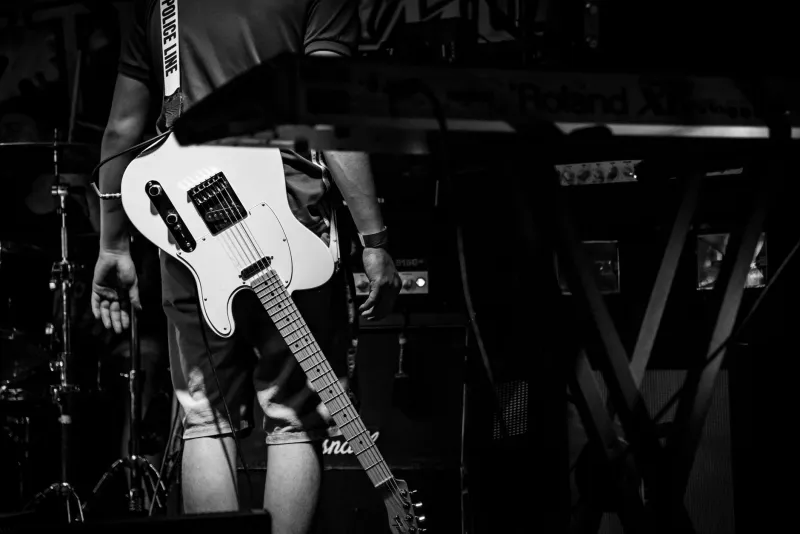
The fact that he achieved all of this on a Fender Telecaster — no fancy effects, no elaborate rig, just a relatively straightforward guitar plugged into an amp — made it all the more democratic. You could, in theory, do this yourself. That accessibility was part of the point.
The Long Shadow
Decades on, the Wilko effect is still being felt. You can trace a line from his choppy Thames Delta attack through punk, through post-punk, through the Britpop era's rediscovery of raw guitar energy, all the way to the garage rock revival of the early 2000s and beyond. Bands like The Libertines, with their ramshackle urgency and their love of early British rock and roll, are part of a tradition that runs directly back through Wilko whether they know it or not.
The man himself, characteristically, was never particularly interested in claiming credit. He just got on with playing — right up until his final years, when even a terminal cancer diagnosis couldn't keep him off a stage. That attitude, that absolute commitment to the work rather than the mythology around it, might be his most enduring legacy of all.
British rock needed rewiring in the mid-1970s, and Wilko Johnson did the job. The fact that he rarely gets thanked for it says more about how we tell music history than it does about the size of his contribution. Next time someone talks about the punk revolution as if it arrived fully formed from nowhere, you know what to say.