Flood Plains and Fury: The Strange Geography That Made Wilko Johnson Inevitable
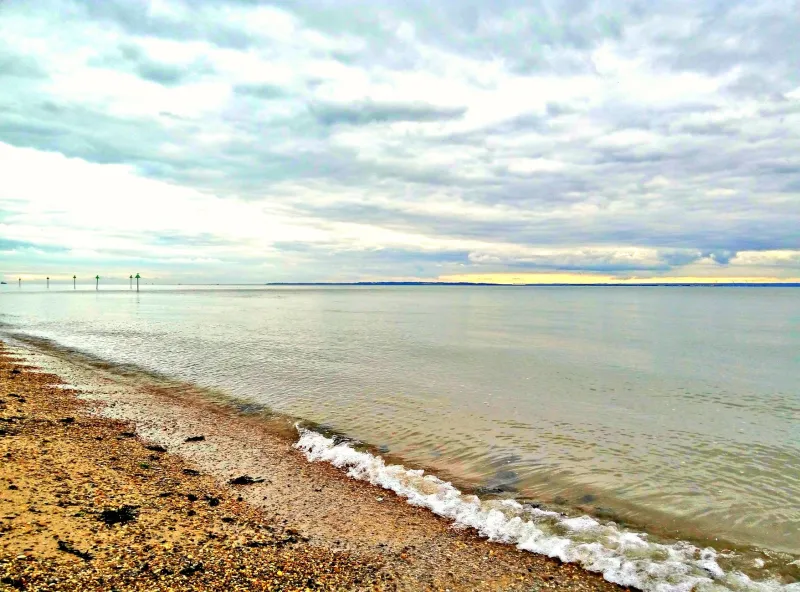
If you drove to Canvey Island without knowing what you were looking for, you might struggle to find it remarkable. Flat land, sea walls, bungalows, a petrochemical plant on the horizon. The Thames estuary stretching away to the north. The kind of place that the rest of England tends to overlook, which is perhaps exactly the point.
Because the places that get overlooked tend to develop their own internal culture. Isolated communities don't wait for permission to be interesting. They build something from what they've got, and what Canvey Island had in the 1960s and early 1970s was a peculiar combination of working-class grit, genuine geographic isolation, and an almost accidental proximity to American music that arrived through the most unlikely of channels.
The Island That Wasn't Quite England
Canvey Island sits in the Thames estuary, connected to the Essex mainland by a couple of bridges but separated in ways that go beyond the physical. For much of its modern history, it existed slightly outside the rhythms of mainstream English life. It wasn't London, with its clubs and scenes and cultural infrastructure. It wasn't a traditional market town with roots going back centuries. It was something stranger — a place that had reinvented itself repeatedly, most recently as a destination for working-class Londoners seeking affordable housing and a bit of breathing room after the war.
The 1953 flood that devastated the island killed 58 people and left an entire community displaced, many never returning. Those who stayed, and those who moved in afterward, shared a particular kind of resilience. You don't rebuild after something like that without developing a certain toughness, a refusal to be sentimental about difficulty.
Wilko Johnson — born John Wilkinson in Canvey in 1947 — grew up in this atmosphere. Not in poverty exactly, but in a community where things were earned rather than assumed, where there was no cultural establishment to impress and no scene to belong to. Just people making do.
The American Music That Arrived by Accident
Here's where Canvey Island's story gets genuinely strange. In the postwar years, American servicemen stationed in and around the Thames estuary brought records with them. Blues, R&B, early rock and roll. Music that wasn't making it onto mainstream British radio, wasn't being sold in the high street shops, but was circulating in communities where Americans had settled or passed through.
For a certain kind of young person in Canvey Island — curious, musical, slightly at odds with the world around them — this was revelatory. Not the sanitised version of American music that the BBC was comfortable broadcasting, but the raw originals. Muddy Waters, Bo Diddley, Howlin' Wolf. Music with edges that hadn't been smoothed off.
Wilko Johnson absorbed this music with the intensity of someone who had nothing else competing for his attention. There was no London scene to distract him, no local musical establishment to conform to. Just the records, and the question of what to do with what they made him feel.
Isolation as Creative Catalyst
It's worth sitting with the significance of geographic isolation in artistic development. The major urban music scenes of the 1960s — London, Liverpool, Manchester — produced extraordinary music, but they also produced a certain kind of conformity. Scenes have rules, even when those rules are about breaking rules. There are influences to absorb, sounds to align with, reputations to manage.
Canvey Island had none of that. What it had was space. Space to develop something idiosyncratic without anyone telling you it was wrong. Space to combine influences in ways that wouldn't have made sense to a London A&R man. Space to be genuinely odd.
The guitar style that Wilko eventually developed — that simultaneous rhythm and lead approach, the choppy right-hand attack, the complete absence of conventional lead guitar decoration — didn't emerge from a scene. It emerged from a person working things out in relative isolation, following the logic of what he heard in the music he loved rather than what he saw other guitarists doing around him.
Working-Class Aesthetics
There's another dimension to Canvey Island's influence that's harder to quantify but equally important: class. The island was, and remains, predominantly working-class. Not in any romanticised folk tradition sense, but in the practical, unsentimental way of communities built around physical work, limited resources, and a healthy suspicion of pretension.
This showed up in Wilko's music as an allergy to excess. No unnecessary notes. No extended solos designed to demonstrate ability. No gap between what was felt and what was played. The music was direct because directness was a value, because showing off was faintly embarrassing, because the point was always the feeling rather than the performance of feeling.
This aesthetic ran completely counter to where mainstream rock was heading in the early 1970s. Progressive rock was getting longer and more complex. Guitar heroes were demonstrating their technical credentials on increasingly elaborate stages. The whole direction of travel was toward more.
Wilko went the other way, and Canvey Island is a significant reason why.
What the Landscape Did
There's something in the landscape itself worth considering. Flat places produce a particular kind of clarity. There's nowhere to hide on the Essex marshes. No hills to soften the horizon, no forests to create mystery. Everything is exposed, right there in front of you.
Wilko's music has that quality. It doesn't build to grand gestures or retreat into atmospheric vagueness. It's right there, immediate, exposed. The riff is the riff. The rhythm is the rhythm. The emotion is the emotion. No mediation, no softening, no landscape to disappear into.
That's not coincidence. That's Canvey Island in the music.
The Town That Made the Sound
When Dr. Feelgood arrived on the London pub rock scene in the early 1970s, they were immediately recognisable as something different. Not because they were technically superior, but because they came from somewhere else — somewhere that had its own logic, its own values, its own sound.
That somewhere was a flat, flood-prone island in the Thames estuary that most people had never heard of and couldn't have found on a map. The fact that this place produced one of the most influential guitar sounds in British rock history is either a beautiful accident or a reminder that great music tends to come from exactly the places you'd least expect it.
Either way, Canvey Island earned its place in the story. Wilko Johnson just happened to be the one who carried it there.