Off the Beat and Into the Fire: How Wilko Johnson's Rhythmic Heresy Changed British Guitar Forever
Put on 'Roxette' and pay attention not to what Wilko Johnson is playing but to when he's playing it. There's a moment in the verse where the guitar lands just slightly ahead of where you expect it — not out of time, never out of time, but displaced in a way that creates a kind of forward lean, a perpetual momentum like a runner who's always about to topple. That feeling isn't accidental. It's the product of a rhythmic sensibility so singular that even accomplished guitarists who've spent years trying to replicate it will tell you, with a mixture of admiration and frustration, that they can't quite get there.
The Mechanics of Unease
To understand what Wilko Johnson was doing rhythmically, it helps to understand what everyone else was doing. By the mid-seventies, British rock guitar had largely settled into a set of conventions. The rhythm guitarist kept time, supported the drummer, stayed out of the way. The lead guitarist soloed over the top. These were distinct roles, and the division between them was considered orderly, professional, correct.
Wilko Johnson rejected this division entirely. He played rhythm and lead simultaneously — not in the showy, look-at-me fashion of a technically ambitious player, but in a way that blurred the categories until they became meaningless. His rhythm playing contained melodic fragments. His melodic phrases were rhythmically percussive. And running through all of it was a syncopated pulse that sat in an uncomfortable relationship with the downbeat.
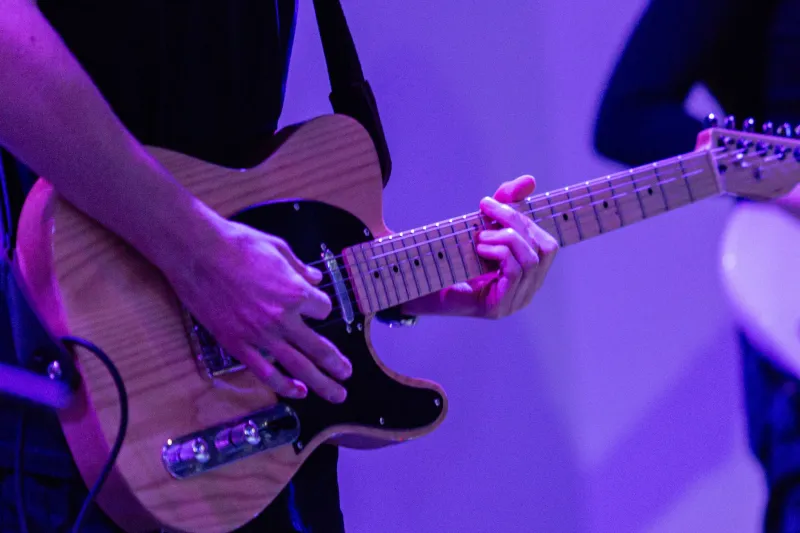
Syncopation — emphasising the offbeat, landing on the 'and' rather than the '1' — wasn't new in 1974. It's baked into blues, jazz, soul, all the American forms that Johnson had absorbed growing up. But the way he applied it to a British pub rock context, with the volume and attack of an amplified Telecaster, produced something that felt genuinely destabilising. Not difficult to listen to. Just impossible to predict.
'She Does It Right' and the Displaced Attack
Listen closely to 'She Does It Right' from 'Down by the Jetty'. The guitar enters in a way that doesn't quite announce itself — it arrives mid-phrase, as if the song has already been going on in another room and you've just walked in. The attack is percussive, the muting tight, and crucially, the accents fall in places that keep wrong-footing the ear even on the tenth listen.
This is the essence of what made Johnson's rhythmic approach so threatening to the establishment. It wasn't aggressive in an obvious way. It didn't shout about its unconventionality. It simply operated according to a different internal logic, one that created tension not through volume or distortion but through rhythmic displacement. The listener's body wants to nod along in a simple way and keeps finding that the music won't quite let it.
That tension is the engine of everything Dr. Feelgood did. Strip away the mythology, the image, the extraordinary live presence, and what you're left with is a band whose power came from rhythmic unease. Sparks and the Big Figure provided a locked, metronomic foundation. Johnson played against it, around it, in ways that made the whole thing feel like it was simultaneously in total control and about to fly apart.
What the Guitar Establishment Couldn't Handle
The mid-seventies guitar establishment — and it was very much an establishment, with its own hierarchies, its favoured techniques, its sense of what constituted good playing — had a particular problem with Wilko Johnson. He wasn't technically flashy enough to dismiss as a showman, but he wasn't following the rules either. His playing didn't resolve in expected ways. His phrases didn't complete themselves with the tidy logic of someone who'd been taught properly.
And yet it worked. Undeniably, viscerally, it worked. Audiences responded to it in a physical way that technically superior playing from the same period simply didn't generate. There's a lesson there about the difference between playing that impresses and playing that moves, but the establishment was slow to learn it.
Punk, when it arrived, got most of the credit for dismantling that establishment. And there's truth in that. But Wilko Johnson had been undermining it rhythmically for two or three years before the Pistols played their first gig. He'd demonstrated that the conventions weren't laws, that you could play with a different internal clock and produce something more alive than anything the rule-followers were making.
Virtually Impossible to Copy Convincingly
Here's the test of a truly distinctive rhythmic approach: can anyone else do it convincingly? With Wilko Johnson, the honest answer is no, not really. Plenty of guitarists have learned the notes. The rhythmic feel — that particular combination of forward momentum, displaced accent, and percussive attack — remains stubbornly his own.
This is partly physical. Johnson's unusual right-hand technique, that windmill strum that functions as both rhythm and attack mechanism, produces a specific tonal character that's hard to replicate with conventional technique. But it's also something harder to quantify: a rhythmic personality, a way of relating to the beat that's as individual as a speaking voice.
The guitarists who come closest to capturing the spirit of it tend to be the ones who've understood the principle rather than copied the execution. Play around the beat rather than on it. Let the rhythm create tension rather than resolve it. Trust the listener's ear to find the groove even when you're not underlining it.
That's the real legacy of Wilko Johnson's rhythmic heresy. Not a technique to be copied but a freedom to be claimed. The freedom to play against expectation, to find the groove in the space between the obvious notes, to make the listener's body do the work of resolution that your guitar refuses to provide. In 1974, that was genuinely radical. Half a century later, it still sounds like nothing else.