Strange Kid on a Strange Island: The Making of a Stage Animal
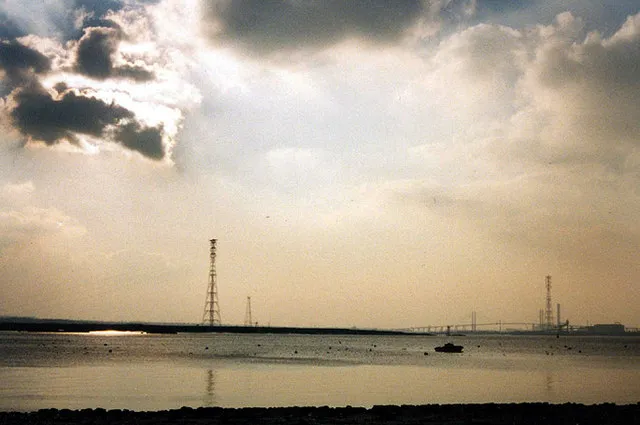
Photo: joe jones, CC BY-SA 2.0, via Wikimedia Commons
Canvey Island in the 1950s was not, by any conventional measure, a glamorous place to grow up. Cut off from the Essex mainland by a network of creeks and accessible only by a single road, it had the particular atmosphere of somewhere that the rest of England had largely forgotten about. The refineries sat on the horizon. The Thames Estuary stretched grey and vast to the north. The island's residents were a self-contained community — working class, practical, not especially given to romantic notions about their surroundings.
Into this landscape, John Wilko Johnson was born in 1947. And the gap between what Canvey Island was and what he eventually became is one of the more interesting distances in British rock history.
The Quiet One
By his own account, Johnson was a shy, introverted child. He was bright — conspicuously so — and found the social world of school more confusing than the interior world of books. He read voraciously. He was interested in history, in literature, in the kind of ideas that didn't come up much in conversation on Canvey Island in the late fifties. He was, in the most affectionate possible sense, a bit of an oddity.
This is worth dwelling on, because the Wilko Johnson that most people know — the one with the wide, unblinking eyes and the barely contained physical energy, the one who stalked the stage like something that had escaped from somewhere — seems like the absolute opposite of a shy bookish kid from Essex. But the connection between those two versions of the same person is actually the key to understanding both of them.
Introverts who find a stage often find it becomes the one place where the rules are different. The social anxiety that makes ordinary life uncomfortable — the small talk, the navigation of other people's expectations — evaporates under lights, in front of a crowd, with a guitar in your hands. The performance is a kind of permission. You are allowed to be enormous. You are expected to be.
First Sounds
The guitar arrived in Johnson's life in the early 1960s, in the way it arrived in the lives of thousands of British teenagers at exactly that moment. Rock and roll was coming across the Atlantic in waves — Chuck Berry, Eddie Cochran, Buddy Holly — and British kids were absorbing it with a ferocity that their American counterparts probably didn't anticipate. For Johnson, the revelation was Mick Green of Johnny Kidd and the Pirates.
Green's approach — playing lead and rhythm simultaneously on a single guitar, creating a sound that was somehow both sparse and full — hit Johnson like a thunderbolt. Here was a way of playing that didn't require a band of ten people. One guitarist, playing with absolute commitment, could fill a room. The economy of it, the efficiency, the sheer physical force of the approach — all of it spoke directly to something Johnson had been trying to articulate without knowing it.
He began to play seriously. Not the way most teenagers play — noodling through chord shapes, learning other people's songs note for note — but with a real focus on developing his own voice. Even at sixteen, seventeen, he was thinking about what he wanted to sound like rather than simply what he could replicate.
Newcastle and the Wider World
Johnson left Canvey Island to study English Literature at Newcastle University, and this chapter of his life tends to get less attention than it deserves. Newcastle in the mid-1960s was a genuinely exciting place — the city had its own music scene, its own energy, and a student culture that was considerably more politically and intellectually engaged than anything available on the Thames Estuary.
For a young man who had spent his adolescence feeling slightly out of step with his surroundings, the university environment was a kind of liberation. He encountered people who read the same things he read, who argued about ideas, who took music seriously as an art form rather than just entertainment. His confidence, by all accounts, began to grow.
He also travelled — most significantly to India, a journey that had a profound effect on him and that he would return to in interviews throughout his life. The experience of being entirely outside your own culture, stripped of the familiar markers of identity, tends either to terrify or to clarify. For Johnson, it seems to have been the latter. He came back with a clearer sense of who he was and what he wanted.
The Canvey Return and the Birth of Feelgood
When Johnson returned to Canvey Island and fell in with Lee Brilleaux, John B. Sparks, and John Martin — who would become The Big Figure — the pieces were finally in place. He was no longer the shy, uncertain teenager trying to navigate a world that didn't quite fit him. He was a man who had read widely, travelled far, thought hard, and developed a guitar style that was entirely his own.
The stage persona that emerged when Dr. Feelgood began playing — the staring eyes, the jerky physicality, the sense of absolute focused intensity — didn't come from nowhere. It came from years of being someone who processed the world internally, who had learned to channel enormous amounts of feeling into controlled expression. The shyness hadn't disappeared. It had been transmuted.
There's a telling detail here. Johnson has spoken about how, on stage, he would stare at a fixed point in the distance rather than making direct eye contact with the crowd. It sounds like a technique for managing anxiety — the same trick that nervous public speakers use. But the effect, from the front of the room, was mesmerising. Those wide, unblinking eyes seemed to be looking through the audience rather than at them, as if Johnson were seeing something the rest of the room couldn't.
What the Island Made
Canvey Island itself deserves credit that it doesn't always receive. The place shaped Johnson in ways that went beyond mere geography. The isolation, the working-class directness, the refinery-and-estuary landscape with its strange industrial beauty — all of it fed into a sensibility that was instinctively suspicious of pretension and drawn to the raw and the authentic.
Johnson never tried to be anything other than what he was. The music he made with Dr. Feelgood didn't reach for sophistication or attempt to disguise its origins. It was Canvey Island music — tough, direct, and completely honest. The shy kid who'd grown up feeling like an outsider had found the one context in which everything that made him different became an asset.
That's the arc, really. Not a story of reinvention, but of discovery. Wilko Johnson didn't become someone else when he stepped onto a stage. He finally became himself.